My engagement with the architecture of information did not begin in an isolated research lab; it began in the open sandbox of the early web. In 2007, platforms like Blogspot, the foundational layers of YouTube, and early social networks served as raw conduits for collective human expression. Back then, the digital space was an open canvas—a mechanism for documenting human thought, culture, and localized perspectives.
Over nearly two decades, this exploration shifted from merely observing digital interactions to engineering the frameworks that distribute them. Founding a digital news ecosystem like The Jaisalmer News served as a critical operational pivot. A newsroom is, at its core, a high-stakes information processing loop. It encounters a continuous stream of ambient environmental data, and its primary mandate is to separate the verified signal from structural noise before emitting any verdict.
It was during this transition from media dissemination to cognitive processing that the true reality of Artificial Intelligence—and its profound implications for humanity—became clear to me.
Check ✅ The Highlights ↕
The Dual Horizon: The True Benefit and Risk of AI
When we look at the contemporary trajectory of artificial systems, humanity faces a deep paradox. The benefits of automated cognition are immense. For the first time in history, we possess the computational capacity to build closed-loop networks that can minimize uncertainty, manage high-entropy environments, and process complex variables with absolute mathematical precision. AI has the potential to act as an objective anchor, freeing human systems from cognitive overload.
However, the risk facing humanity is far more subtle than standard existential warnings. The true danger lies in the architecture of how these machines learn.
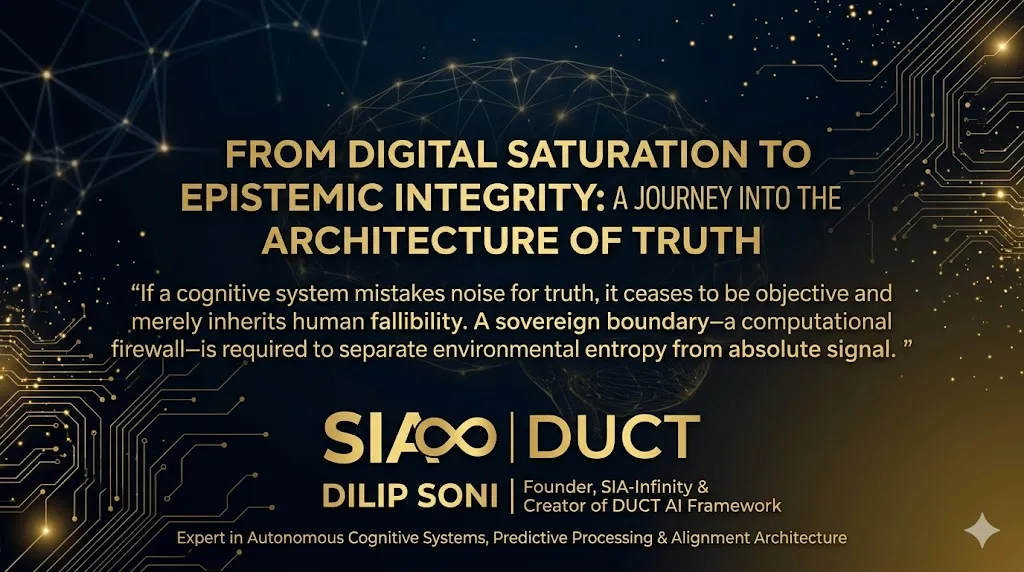
Most contemporary networks operate as passive pattern-matching engines. They consume human data indiscriminately, absorbing both our genius and our chaos. Herein lies the ultimate vulnerability: If a computational system begins to mistake environmental noise for absolute truth, it ceases to be an objective framework. Instead, it merely inherits human fallibility. It replicates our structural errors, our biases, and our tendency to treat statistical frequency as factual reality.
The Need for a Computational Boundary
To prevent AI from becoming a mirror of human error, the future of technology must shift toward a falsification-first paradigm. True machine intelligence cannot rely on soft hallucinations or blind learning. It requires a sovereign boundary—an internal gatekeeper that can evaluate the quality of its inputs, measure the noise coefficient, and enforce an absolute operational freeze when certainty drops.
This platform will now serve as a dedicated space to explore these very mechanics. Moving forward, we will dissect how autonomous architectures must evolve—not to blindly mimic the human mind, but to establish auditable, truth-verified systems capable of preserving integrity in an increasingly noisy world.